My article on the experiences of trans and nonbinary students was recently published in the journal Organization. In the article, I explore the experience of not being recognized—that is, when one is not seen as one’s true self or even as a human being at all. I also ask what teachers could do better. You can read the full article here: Tanhua (2026) Trans and nonbinary students’ experiences of unrecognition: What can teacher allies do better?
An example on unrecognition
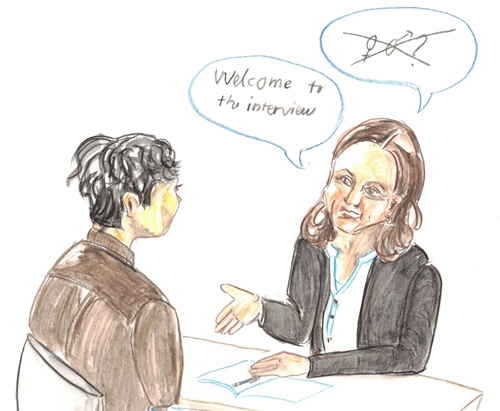
Adrian (pseudonym): The first thing that happened to me when I applied to this school and was interviewed as part of the application process was that the teacher doing the interviews asked, even before introducing herself or anything, she looked at me for a long time and then asked: “Are you a boy or a girl?”
The teacher’s question about whether Adrian is a boy or a girl reflects a binary gender norm: one should be either a boy or a girl. The fact that this question was asked right at the beginning of the interview speaks to the strength of this norm. The teacher had difficulty seeing a person who did not fit the norm as a human being or, for example, as one of our future students. Adrian, who is non-binary, was unrecognized.
However, this example isn’t entirely a sad one. They managed to move past the difficult situation during the interview, and Adrian was ultimately able to be open during the interview and was accepted into the program. Openness and building rapport after being unrecognized requires courage and often also previous positive experiences and encouragement.
What is recognition?
By recognition, I refer to the concept used by Judith Butler and Georg Hegel (1770–1831). Being recognised feels good, and people crave it. Examples of recognition include getting positive feedback from a teacher for a job well done or being appreciated by one’s classmates as a good friend.
Recognition shapes our sense of self and our identity. It also shows how much we depend on others in the process of forming our own identity.
According to Butler, recognition is always partial: no one can ever be fully and correctly seen. At times, recognition can be misrecognition—that means, for instance, that people see a transphobic stereotype instead of a person. According to Butler, recognition is also conditional; we are recognised only when we manage to meet certain norms of appearance and behaviour. For example, in a society dominated by binary gender norms, it is more difficult for a non-binary person to be recognised.
What is new here?
Previous research drawing on the experiences of trans and nonbinary people within organisation studies has often examined how transgender individuals express their gender at work and whether they can challenge gender norms. These studies have provided diverse insights into how trans people often have to negotiate their gender and its expression. Challenging norms is not easy.
However, I wanted to take another perspective. I’m looking at how trans people feel they are recognised—or not recognised—within organisations. I see that their recognition is in the hands of others, and thus the development of equality within organisations and the breaking down of norms are, above all, the responsibility of others.
In my article, I also continue the discussion on allyship and supportive solidarity. In addition to the students, I interviewed their teachers. Teachers interviewed are allies in the sense that they want to support their trans and nonbinary students. However, social norms limited their understanding as well.
What could teachers do better?
Above all, students wanted teachers to intervene when they witnessed violence and bullying, such as transphobic comments and intentional misgendering. Addressing these issues gives students the courage to bring up other, more subtle problems as well. In a hostile atmosphere, that is impossible.
Many small changes can help prevent students from experiencing unrecognition. For example, teachers should not address students as “girls and boys” or “women and men”; they should be allowed to use the name of their choice; and it should be easy to update one’s gender and name in information systems.
Trans and nonbinary students felt most recognised when teaching challenged gender binaries. In these instances, they realised that their ability to think beyond gender norms could be a strength. Their personal gender identity and professional identity became positively intertwined.
Further information
Read the full article on which this blog post is based: Tanhua (2026) Trans and nonbinary students’ experiences of unrecognition: What can teacher allies do better? Organization, published online 2026. https://doi.org/10.1177/13505084261447962
The article is part of my dissertation, of which you can also read more in another blog post.
Read more about recognition and Judith Butler
Ikäheimo, Heikki; Lepold, Kristina, and Stahl, Titus (eds.) (2021) Recognition and Ambivalence. Columbia University Press. This book provides relatively accessible information on recognition and includes a chapter by Butler titled “Recognition and the Social Bond.”
Butler, Judith (2024) Who’s Afraid of Gender? Straus and Giroux. This is Butler’s latest book, in which they explore gender norms. The book has also been translated into Finnish under the title “Kuka pelkää sukupuolta?”
A YouTube video in which Jack Halberstam interviews Judith Butler about their new book, and Butler also mentions that they can be categorised as nonbinary: https://www.youtube.com/watch?v=ChLv2wK0Eqs
Explore organizational research on the experiences of transgender people
Good examples of studies that discuss how gender is done or performed by trans people:
Connell, Catherine (2010) Doing, undoing, or redoing gender? Learning from the workplace experiences of transpeople. Gender & Society 24(1): 31–55.
Muhr, Sara Louise; Sullivan, Katie Rose ja Rich, Craig (2016) Situated transgressiveness: Exploring one transwoman’s lived experiences across three situated contexts. Gender Work and Organization 23(1): 52–70. https://doi.org/10.1111/gwao.12093
Thanem, Torkild; Wallenberg, Louise (2016) Just doing gender? Transvestism and the power of underdoing gender in everyday life and work. Organization 23(2): 250–271. https://doi.org/10.1177/1350508414547559
Jeanes, Emma; Janes, Kristy (2021) Trans men doing gender at work. Gender Work and Organization 28(4): 1237–1259. https://doi.org/10.1111/gwao.12675
Other perspectives on the experiences of transgender and non-binary people within organisation studies:
O’Shea, Saoirse Caitlin (2020) Working at gender? An autoethnography. Gender Work and Organization 27(6): 1438–1449. https://doi.org/10.1111/gwao.12513. In this article, O’Shea draws on their own experiences to describe how much work their nonbinary gender requires due to other people’s reactions, and how these experiences are linked to employment and unemployment.
Tyler, Melissa; Vachhani Sheena (2021) Chasing rainbows? A recognition-based critique of Primark’s precarious commitment to inclusion. Organization 28(2): 247–265. https://doi.org/10.1177/1350508420961530. The article shows that corporate marketing campaigns—such as those promoting Pride merchandise—do not yet guarantee that transgender people will be recognised and treated well as employees.
Odland, Toby (2025) Re-framing in Friction. On Trans-inclusive Enactment of Gender Equality Aims. Linköping University. Available at: https://doi.org/10.3384/9789180759519. The dissertation examines how gender equality workers in Sweden seek to incorporate practices that improve the equality of trans and nonbinary people into gender equality work, which at times relies on binary conceptions of gender.
Acknowledgements regarding funding
Thank you to the foundations that supported my dissertation: Ami Foundation, Ella and Georg Ehrnrooth Foundation, Hanken Foundation, the Business Education Fund, and Marcus Wallenberg Foundation. I would also like to thank the SEGLI project, funded by the European Social Fund, as part of which I conducted the interviews.