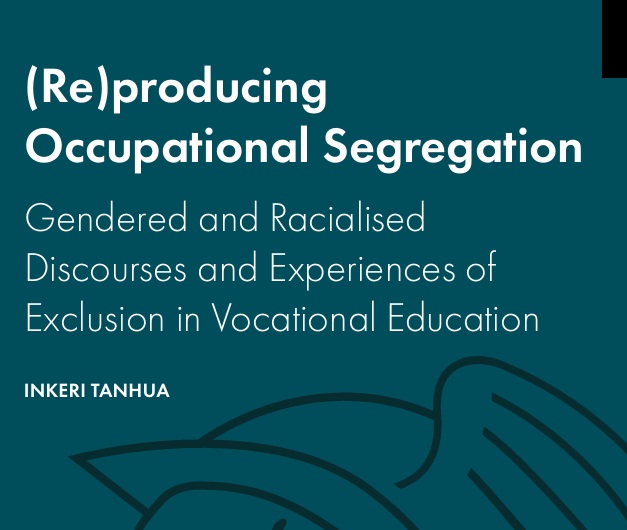
Occupational segregation, the systematic concentration of different demographic groups in different fields and occupations, is strong in Finland. My research shows that gendered and racialised stereotypical assumptions reproduce segregation in vocational education.
Persistent stereotypes still shape who does which jobs in Finland
For instance, the level of gender segregation is regularly measured in Finland, and it continues to be strong. Recently, some studies have claimed that differing interests and ability perceptions reproduce gender segregation.
Tanhua’s research shows how stereotypical assumptions lead to segregation. They also influence the development of interest.
“For example, the images associated with technology education are gendered, which affects who becomes interested in these programmes and how they are perceived within them,” Tanhua explains.
Although stereotypes are persistent, gender stereotypes associated with a particular profession can change.
“This means that women do not have an innate lack of interest in performing tasks seen as masculine; rather, their desire to take on these roles depends on the situation and how they are treated at work,” Tanhua summarises.
Their study also includes transgender and non-binary students. According to Tanhua, it’s important to address gender-based divisions other than the one between women and men. An example of segregation among trans and non-binary people is that they often avoid men-dominated fields.
“The experiences of transgender and non-binary students are marked by a lack of recognition – in other words, they are not always recognised and valued for who they are,” Tanhua explains.
This also affects their choice of career and their studies, as situations in which they feel valued for who they are become very important.
The perceptions associated with migrants are also rife with stereotypes. Tanhua points out that one example of a stereotypical generalisation is the claim that vocational school is suitable for migrants.
“The downside of these seemingly positive discourses is that high school and university are, in a sense, deemed unsuitable. The assumptions of who is considered a migrant also reflect racialisation, and discrimination can be hidden behind discourses that emphasise language skills,” Tanhua adds.
You can read this press release also in Swedish.
More information
You can read the whole thesis here: Tanhua (2026) (Re)producing occupational segregation: Discourses and experiences of exclusion in vocational education, Doctoral dissertation, Hanken School of Economics.
Article 1: Tanhua (2023) The gendering of technology education: minority ethnic students’ experiences of a women-dominated vocational dental technology programme, NORA – Nordic Journal of Feminist and Gender Research, 31:3, 264–278.
Article 2: Tanhua (2026) Trans and nonbinary students’ experiences of unrecognition: What can teacher allies do better? Organization, 00:00, 1–22.
Article 3: Tanhua (2025) Racialised discourses on migrants and language skills in Finnish vocational education, Journal of Vocational Education & Training, 00:00, 1–18.
The defence
The defence took place at Hanken School of Economics on May 22, 2026.
Opponent: Professor Sara Louise Muhr, Copenhagen Business School
Kustos: Professor Janne Tienari, Hanken School of Economics