My article on the gendering of technology education was published online in December 2022 and in print in 2023 in NORA (Nordic Journal of Feminist and Gender Research). The article focuses on dental technology, which is a women-dominated technology programme. You can download the full text here: Tanhua (2023) The Gendering of Technology Education: minority Ethnic Students’ Experiences of a Women-Dominated Vocational Dental Technology Programme.
Does technology have to have a gender?
It would be great if the stereotypes associated with technology weren’t so gendered. That would make it easier for everyone to feel that any technology-related programme or occupation is suitable for them. Unfortunately, however, technology does have a gender, specifically in the sense that different technologies and technology-related programmes and occupations are perceived either as masculine or feminine.
Many researchers have demonstrated how technology is associated with men and masculinities (Cockburn, 1985; Faulkner, 2000; Mellström, 2002; Vehviläinen, 2005; Wajcman, 2010). Marja Vehviläinen (2015) also points out that although the gendered nature of technology has been extensively studied, it is often denied in everyday conversation.
As one example of the gendering of technology, Faulkner (2000, 2001) points out that we often perceive the technical and the social as opposites and associate the former more with men and the latter more with women. This may lead, for example, to the kind of thinking that suggests one should not choose a technology-related occupation if one is socially gifted. This association is, of course, highly stereotypical; in reality, many tech jobs require social skills, such as the ability to work in teams.
Dental technology can be perceived as both feminine and masculine
Of course, not all technical fields are considered exclusively masculine or associated with men. Dental technology is a good example of this. The field is dominated by women, and the students I interviewed for my article described the subject in both masculine and feminine terms.
The main discourse defining dental technology as a women-dominated field was the portrayal of the work as detailed work done with one’s hands. For many of the students interviewed, the image of detailed work with small instruments had been a key reason for choosing the programme.
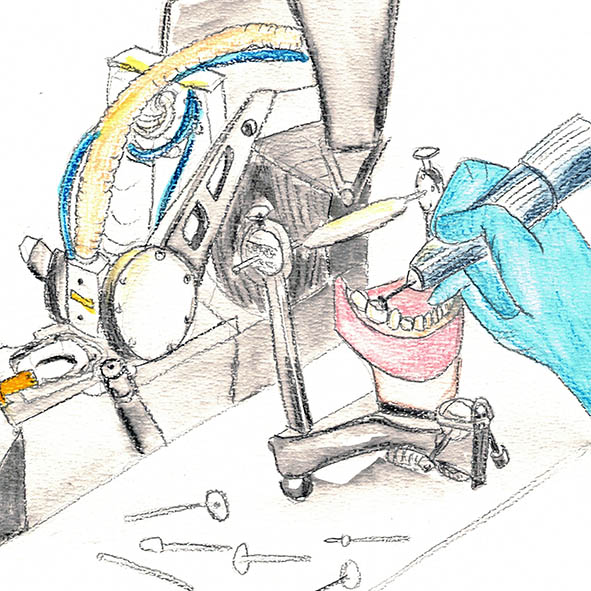
However, dental technology requires not only precision but also physical strength, and it involves the use of large machines. Some of the work steps are also messy. In particular, women studying in the field reported that these aspects of dental technology had come as a surprise to them during their training. However, they were not discouraged by the fact that their field included tasks considered masculine; rather, they were proud to have learned these skills as well.
Practical implications
Although the women studying dental technology had chosen the field based on its feminine image, they were willing to accept that the actual work did not fully match that image. This observation points to potential for change. Women (including those who identify as feminine) are open to all kinds of jobs in the technical field, as long as they can familiarise themselves with the work and see it as fitting their own identity.
Educational providers and employers looking to hire new employees can draw on a wide range of images. These images can be played with, allowing many fields to appear both masculine and feminine. Of course, it is also important to present as accurate a picture as possible of each field and job.
It is important to note that not all technology-related fields are dominated by men. Even tech fields with a majority of women should be referred to as technology-related fields and taken into account when discussing the men-dominated nature of tech fields and gender segregation in the workforce. Taking this into account may encourage women to consider all tech fields as potential career options.
What is new here?
Although the gender segregation of technology-related fields has been extensively studied since the 1980s, there is still very little research on how women-dominated technical fields become gender-segregated. Further research on this topic is therefore needed! Furthermore, to my knowledge, this topic has not been studied in the context of vocational education and training (VET) prior to this article.
One good example of research focusing on higher education institutions is the dissertation written by Andreas Ottemo at the University of Gothenburg. Ottemo noted that chemical engineering is often viewed as a field with a high proportion of women, yet it is also considered by both students and faculty to be an extremely technical and difficult field. Why do women choose one of the most difficult tech fields?
According to Ottemo, women in particular are drawn to studying chemical engineering because, in their minds, the field is linked to the chemistry courses and laboratory work they did in high school and general upper-secondary school. For many students, the technology-related nature of the programme only became apparent during their studies. However, they felt content in their chosen programme, and the student culture had developed in such a way that it supported a wide variety of students. Just like the dental technology students, these students had found fulfillment in the tech programme, even though they had initially chosen it based on somewhat incomplete impressions.
Another new point raised in the article is the intersectional approach. In vocational education, and particularly in dental technology programmes, there are many students who have moved to Finland as adults. In total, I interviewed 11 dental technology students, and 9 of them had moved to Finland as adults or teenagers. These students were extremely concerned about their employment prospects. The three migrant men in the programme had faced even more difficulties than the women.
Methods
For this article, I interviewed dental technology students. The interviewees were selected from a single class of students studying dental technology in a programme for students with a basic education. Eleven of the class’s twelve students participated in the interviews. Of the students interviewed, 8 were women and 3 were men. The interviews were analysed using discourse analysis.
The interviews were conducted as part of the European Social Fund’s SEGLI project, which investigated the reasons behind the gender-based division of labour in the workforce and in education. Further analysis and the article are part of my PhD work at Hanken School of Economics. The writing of the article was supported by the Marcus Wallenberg Foundation and the Foundation for Economic Education.
More information
Read the full article on which this blog post is based here: Tanhua (2023) The Gendering of Technology Education: minority Ethnic Students’ Experiences of a Women-Dominated Vocational Dental Technology Programme
Read Wendy Faulkner’s (2000) article Dualisms, Hierarchies and Gender in Engineering on the dichotomies in our thinking, or borrow the book Tieto, tiede ja sukupuoli (2015), in which Marja Vehviläinen fluently summarises international literature in Finnish in the chapter “Teknologian miehisten käytäntöjen jäljillä: teknologian sukupuolen tutkimuksesta”.
Check out this recent Nordic study
Andreas Ottemo’s (2015), doctoral dissertation completed at the University of Gothenburg: Kön, Kropp, Begär Och Teknik: Passion Och Instrumentalitet På Två Tekniska Högskoleprogram [Gender, Body, Desire, and Technology: Passion and Instrumentality in Two Technical University Programs]
Julia Orupabo’s (2018) article, Cultural stereotypes and professional self-socialisation in the transition from education to work analyses the experiences of students in information technology, biomedicine, and nursing in Norway.
Take advantage of the best practices developed in projects (in Finnish)
Ota käyttöön NAU-hankkeen laatimia tekniikan alan tasa-arvon edistämisen keinoja, sekä lue blogeja ja uratarinoita tekniikan alalta.
Seuraa terveyden ja hyvinvoinninlaitoksen hanketta Segregaation purku – työkaluja tasa-arvoisempaan työelämään ja lue hankkeen blogiteksti Jokaisella työpaikalla tulisi olla käytössä keinoja sukupuolen mukaisen eriytymisen purkamiseksi.
Lue SEGLI-hankkeen (2016-2019) julkaisut Miksi sukupuoli vaikuttaa alavalintaan? ja Koulutusvalintoihin vaikuttaneet syyt kahdella erilaisella teknisellä alalla, sekä selaa hankkeen oppilaitosten kanssa kehittämiä käytäntöjä segregaation purkamiseksi.